
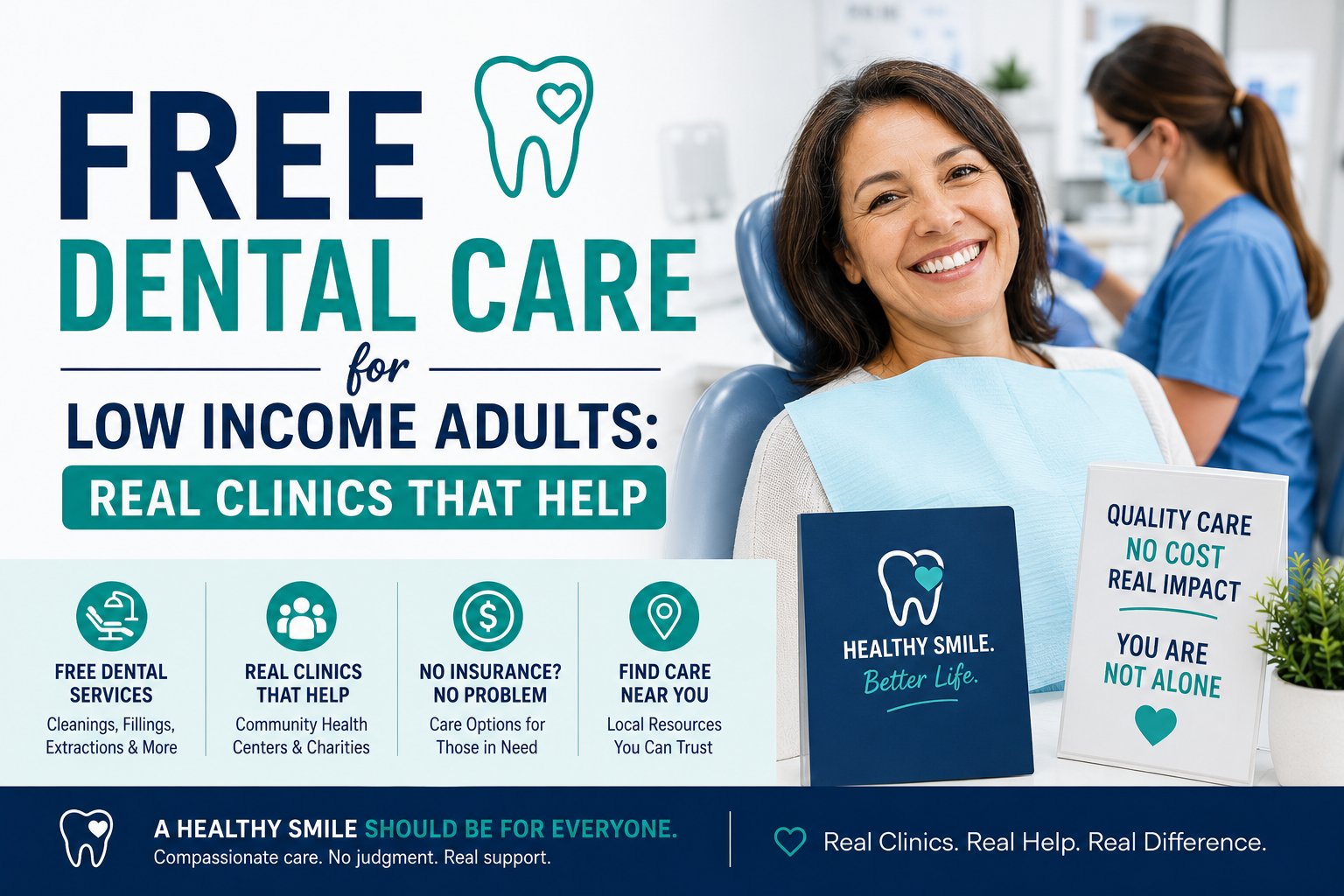
If your tooth hurts but your wallet is empty, you’re not alone. Dental care is one of the most expensive healthcare costs, and most insurance plans don’t cover it well. For low-income adults, a simple cavity can turn into a root canal crisis simply because you couldn’t afford a checkup. But here’s the good news: free dental care for low income adults is real, and more available than you might think.
This guide walks you through every real option to get dental treatment without insurance or with very limited income. From community health centers that charge based on what you earn to dental schools where supervised students provide affordable care, you’ll learn exactly where to go and how to apply.
Community Health Centers Offer Affordable Dental Care
Community health centers (also called Federally Qualified Health Centers or FQHCs) are one of the best options for free dental care for low income adults. These centers receive federal funding to serve underserved communities, and they offer dental services on a sliding fee scale.
What does sliding scale mean? It means your bill is based on your income. If you’re at or below the federal poverty level, you might pay as little as $20 for a dental visit. Some centers even offer completely free basic services for uninsured patients.
There are over 1,400 community health centers across the US, with nearly 10,000 clinic locations. To find one near you, use the HRSA Find a Health Center tool. Just enter your zip code, and it will show you the closest options with contact information.
Services at these centers typically include cleanings, fillings, extractions, and X-rays. Some provide dentures and root canals too. You don’t need insurance, and many centers help you apply for coverage if you qualify.
Dental Schools Provide Low-Cost Treatment
Dental schools are another excellent source of low cost dental care. Students need real patients to practice on, and experienced faculty dentists supervise every procedure. The result is quality care at a fraction of the private practice price.
A filling at a dental school might cost $30 to $80, compared to $200 or more at a regular dentist. Cleanings can be as low as $20. More complex procedures like root canals or crowns can save you hundreds of dollars.
The tradeoff is time. Appointments at dental schools take longer because students work slowly and instructors check every step. A simple filling might take two hours instead of 30 minutes. But if your schedule is flexible, the savings are worth it.
To find a dental school near you:
- Search for “dental school [your city or state]” on Google
- Call the school’s clinic directly and ask about their pricing for uninsured patients
- Ask if they offer payment plans for larger procedures
Most dental schools are associated with universities, so start by checking if your state has a dental college. Some well-known programs include the University of Texas School of Dentistry, UCLA School of Dentistry, and NYU College of Dentistry, but there are programs in nearly every state.
Nonprofit Dental Clinics and Free Events
Several nonprofit organizations run free dental clinics specifically for people who can’t afford care. These are often event-based or operate on specific days of the month.
Here are some of the biggest programs:
- Mission of Mercy runs free dental clinics in multiple states. They provide cleanings, fillings, and extractions at no cost. Check their website for upcoming events near you.
- Dentistry from the Heart organizes free dental days where volunteer dentists see patients for free. Events are listed on their site.
- America’s Dentists Care Foundation coordinates large-scale free clinics across the country.
- Give Kids a Smile focuses on children, but some locations also serve adults during certain events.
Many local churches and charities also host annual or quarterly free dental days. Call your local health department and ask if they know about any upcoming free dental clinics in your area.
Free and Low-Cost Care by Procedure Type
Not all dental procedures are equally available through low-cost programs. Here’s what you can typically find for each type of care:
Cleanings and exams are the most widely available free or low-cost services. Community health centers and dental schools both offer these regularly. Some free events only do cleanings and basic exams.
Fillings are available at most sliding-scale clinics and dental schools. The cost ranges from free to around $80 per filling at a dental school.
Extractions are common at free dental events. If a tooth can’t be saved, most low-cost clinics will pull it for a low fee. Dental schools charge around $30 to $60 for simple extractions.
Dentures and partials are harder to find cheaply, but some community health centers offer them on a sliding scale. Dental schools may offer discounts on dentures, though they still cost several hundred dollars.
Root canals and crowns are the most expensive to get through discount programs. Dental schools are your best bet, where a root canal might cost $200 to $500 instead of $1,000+.
How to Apply for Help With Dental Costs
Beyond finding a clinic, you may qualify for programs that help cover dental expenses:
- Medicaid covers dental care for adults in some states. Coverage varies widely — some states cover only emergency extractions, while others provide full preventive and restorative care. Check your state’s Medicaid dental benefits on the Medicaid website.
- Discount dental plans are not insurance, but they offer reduced rates at participating dentists. Plans cost around $100 to $200 per year and can save you 10% to 60% on dental procedures.
- Health Insurance Marketplace plans sometimes include pediatric dental, but adult dental coverage is limited. During open enrollment, compare plans that include dental benefits.
- State and local programs exist in many areas. Call 2-1-1 from any phone to speak with a community resource specialist who can tell you about local dental assistance programs.
The best dental care without insurance strategy is to combine options. Use a community health center for regular cleanings and exams, then turn to a dental school if you need more complex work.
Frequently Asked Questions
Can I get free dental care if I have no income at all?
Yes. Community health centers and free clinic events do not require you to have income. Many serve homeless individuals and those with zero income. Bring any form of ID if you have it.
Do community health centers verify income?
Most ask for proof of income to set your sliding fee rate. Pay stubs, tax returns, or a letter from your employer work. If you have no income, they usually have a minimum fee or waive it entirely.
How much does a dental school filling cost?
Dental school fillings typically cost between $30 and $80, depending on the complexity and the school. This is significantly less than the $150 to $400 you’d pay at a private dentist.
Is the quality of dental school care any good?
Yes. Every procedure is supervised by licensed, experienced faculty dentists. Students are held to very high standards. Many people prefer dental schools because the care is thorough and they spend more time explaining everything.
How do I find free dental clinics near me?
Use the HRSA Find a Health Center tool to locate community health centers. Also call 2-1-1 or search for “free dental clinic [your city]” to find nonprofit events in your area.
Your Next Step
You don’t have to suffer with tooth pain just because you’re on a tight budget. Free dental care for low income adults is available through community health centers, dental schools, and nonprofit clinics across the country. Your first move should be finding the nearest community health center using the HRSA tool above. Call them, ask about their dental services and sliding fee scale, and make an appointment. Your smile — and your health — are worth it.
If this guide helped you, check out our resources on financial assistance programs that can also help you cover unexpected medical and dental costs.